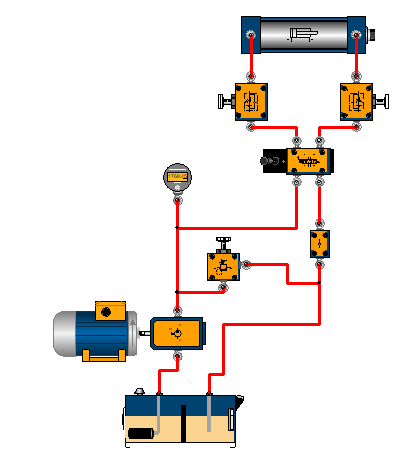
Having invested in Automation Studio last year, we have used the programme to develop both training material and also simulate some circuits for our customers. The cut through view of hydraulic components is very useful for training and helps understanding the internal structure of hydraulic components.
Why are hydraulic systems simulation useful? It is good to have a lot of experience and with experience, designers usually know what works and what components to use. Calculating pressure drops through pipework and valves and heat generation can be time consuming. At the start of most projects a hydraulic schematic has to be drawn. You can do this in Automation Studio and at the same time set the operating parameters of the components ready for simulation. Then with minimal effort, pressure drops and heat generation results can be simulated.
Simulation is also good for existing hydraulic system problems. If you have a problems with a system, try simulating it as this could quickly pin point the problem. Back in the early days of MGR Fluid Power we simulated a hydraulic accumulator system on a Wave Generation Machine. The simulation involved determining the time the accumulator pressure reduced to a certain level due to hydraulic valve leakage. Recently we simulated a problem with a hose burst valve firing and the simulated results showed the maximum flowrate from the cylinder, which was very close to the measured flowrate.
If you are looking at a complex hydraulic system design and need to de risk the design before manufacture, then hydraulic system simulation is something you should consider. Alternatively if you have a problem with system performance, this is again a task that can be done with simulation.
We will need an up to date hydraulic schematic and bill of materials. Also we will need to know what simulation you need for example to prove the pressure and flow performance or do you have a performance issue.